
#4 - Celebrating Individual Contributors
February 2026:
We often hear the quote “Employees are our most valuable asset.” This is likely a sincere gesture by most, but it doesn’t reconcile with research on the experiences of individual contributors. We’ve learned that senior managers are largely unaware of, or may not want to know about, the daily experiences of these front-line workers. This results from top-down, command-and-control methods that are a leading cause of stress and burnout, exacting a heavy toll on workers and costing organizations millions in the form of disengagement, poor performance, absenteeism, and turnover (Davis 2021; Pfeffer 2018).
Celebrating Individual Contributors: “Employee health is an indicator of the health of the system” (Pfeffer, 2018).
Why care about individual contributors? Because they have direct, daily, hands-on involvement designing, developing, delivering, and supporting products and services. They work face-to-face with prospects, paying customers, suppliers, regulators, and others, establishing first impressions and lasting memories that influence customer satisfaction and repeat business. They are the lifeblood of any organization, allowing it to fulfill its purpose. Unfortunately, current methods of management and organization actually create significant challenges for them, overcomplicating their work and negatively affecting operational outcomes.
This lack of appreciation for frontline, individual contributors is not surprising. Research and literature largely focus on senior management, university courses and textbooks don’t offer insights on how to improve individual contributor experiences, and phenomena such as the great resignation and quiet quitting have not triggered a meaningful inquiry into root causes.
Recent research into individual contributor experiences under different structures clearly demonstrates the existence of two debilitating challenges: task uncertainty (TU, reduced task clarity related to understanding how to convert inputs into outputs) and task interdependence (TI, increased task reliance on others’ activities, knowledge, or authority). The difficulties of TU and TI manifest in the form of complexity, rigidity, destructive behaviors, disengagement, fear, distrust, and other dysfunctions (Barbeau 2022). This indicates that the very foundations of how we currently think about organizing and managing (i.e., our best practices) in reality create significant complications for individual contributors.
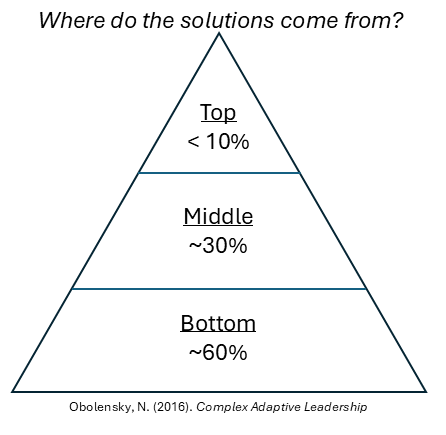
Research by Obolensky (2016) demonstrated that individual contributors provided ~60% of the best ideas and viable solutions to challenges in navigating changes in strategy, culture, and reorganization, whereas top-level managers provided less than 10% and middle level managers provided ~30%. This discrepancy leads to continued failure to address real issues and organizational decline as decision-making leaders become ever distant and cut off from the realities at the bottom.
Our message to anyone in senior management is: It’s not about you. It’s about how well the entire organizational system functions in terms of fulfilling its purpose of effectively, efficiently, and consistently creating and delivering value for customers. Therefore, we define the role of management as creating and maintaining the right environmental conditions in which individual contributors are allowed to do their best work. When individual contributors are successful, products and services will be properly designed, developed, delivered, and supported, thus making customers successful and fulfilling the organization’s purpose. Achieving these systems-based outcomes is the best way to define the success of management practices.
Recommendations: If employees are the most important asset, and individual contributors are highly knowledgeable and valuable participants in organizational success, then improving their environmental conditions is worthy of investment. Here, environment refers to the internal dynamics of the entire organization, the whole system that individual contributors need to continuously understand, navigate, and survive. See our previous newsletters: “Managing for Impact,” “Becoming a Systems Thinker,” and “Understanding the People Problem.” Addressing the following will also help customers and the organization:
Clarity. Every individual contributor should be intimately aware of the organization’s purpose, the desired customer-facing outcomes, and how they contribute to both. Reducing their perspective to only see a departmental view is demotivating and limits problem-solving and innovation.
Alignment. Recognize organizational interdependencies and actively work to ensure individual task integrity (TU) and streamline process handoffs (TI). Expecting individual contributors to overcome a poorly designed system will frustrate all, slow process execution, and reduce quality.
Voice. Seek out, listen to, and respect frontline voices and allow them to engage in decision-making, job control, and autonomy (Pfeffer 2018). Deprioritizing or silencing frontline voices destroys trust, engagement, and agility and kills strategic change (Pregmark and Beer 2025).
Dignity. Offer individual contributors a meaningful alternative to earning appreciation and respect other than by climbing the corporate ladder. Using a single means of recognition via vertical ascension triggers competition and misinformation and adds to workplace toxicity.
Support. In addition to creating social support programs (Pfeffer 2018), actively monitor for and proactively address signs of stress, burnout, or disengagement. Avoiding or pretending that employees don’t require psychological safety in the workplace will not make it go away.
If we seek to improve organizational performance, we must first seek to understand and improve the working conditions of individual contributors. Investments in better management are still warranted, but we also need an equal or even greater investment in creating and maintaining the right environmental conditions that allow frontline workers to do their best work.
Stay tuned for MORe insights and recommendations.
References:
Barbeau, Andrew R. 2022. “Individual Contributor Experiences of Task Uncertainty and Task Interdependence Under Different Structures.” PhD diss., Walden University. Publication No. 29393130. ProQuest Dissertations & Theses Global.
Davis, Paula. 2021. Beating Burnout at Work: Why Teams Hold the Secret to Well-Being and Resilience. Wharton School Press.
Obolensky, Nick. 2016. Complex Adaptive Leadership: Embracing Paradox and Uncertainty. 2nd ed. Taylor & Francis Group.
Pfeffer, Jeffrey. 2018. Dying for a Paycheck: How Modern Management Harms Employee Health and Company Performance and What We Can Do About It. Harper Business.
Pregmark, Johanna E., and Michael Beer. 2025. “The Silent Killers of Strategic Change in a VUCA World.” Academy of Management Perspectives, 1–17. https://doi.org/10.5465/amp.2024.0093.
The very foundations of how we currently think about organizing and managing, i.e., our best practices, in reality, create significant complications for individual contributors.
Our message to anyone in senior management is, it’s not about you.