
#8 - The Employee Engagement Pandemic - Why We Need “5.0”
June-July 2026:
How would you answer the following question? “What is the single most important factor in achieving exceptional and sustained organizational performance?” The answer, which is backed by research, is employee engagement. Engaged employees consistently outperform their disengaged counterparts, are better with customers, and are more adaptable to disruption and change. Organizations that wish to improve performance, enhance customer satisfaction, or become better at any type of change should start by addressing their employee engagement issues.
The Employee Engagement Pandemic – Why We Need “5.0”
Employee engagement refers to their level of intellectual involvement and emotional enthusiasm (Harter and Pendell 2026) or the measure of their invested intellectual and emotional energy and concentration toward achieving positive organizational outcomes (Shuck 2019). It can also be understood by terms such as job satisfaction, morale, esprit de corps, or devotion. High levels of engagement are critical to the success of employees and their organizations. It improves well-being, retention, productivity, and absenteeism (Gallup 2026). Unfortunately, global employee engagement declined 2% between 2023 and 2025, representing approximately forty-two million fewer engaged employees (Harter and Pendell 2026).
Historically, low engagement levels have been associated with individual contributors. In their latest report, Gallup (Harter and Pendell 2026) reports that managers now account for much of the recent decline, indicating that their engagement levels are getting much closer to those they lead. This is dangerous, as managers are often the primary way individual contributors experience their employer. Low engagement, among managers or individual contributors, results in:
Feelings of disconnection and detachment from employers.
A higher likelihood that employees will look for another job.
Reduced productivity and overall organizational growth.
An inability of organizations to weather disruption and change (Harter and Pendell 2026).
These consequences have serious impacts on the individuals involved but also on organizational performance, with low engagement costing the world economy approximately $10 trillion in 2025 alone. Employee engagement deserves pandemic status, as it is a global phenomenon that is severely affecting the well-being of millions of people and the organizations they work for. The shocking numbers speak for themselves, approximately:
68% of US employees are disengaged.
90% of EU employees (on average) are disengaged.
92% of Japanese employees are disengaged (Harter and Pendell 2026).
Disengagement is also a highly contagious disease. Negative attitudes and behaviors can easily and quickly spread to others. Even small expressions (words or behaviors) of dissatisfaction by influential employees can stick in the minds of others, having a dramatic and viral effect until reaching a tipping point (Gladwell 2000), where the majority of people adopt the same views. Once a tipping point is reached, it is very difficult to reverse the effects.
We must see disengagement for what it truly is. It is synonymous with other natural processes where forces quietly and unknowingly eat away at the core of an organism, degrading its integrity until it collapses. Similar examples include dry rot in trees or cancer in the human body. In an organizational context, apathy and negativity rob employees of their creative energies, crowd out healthy behaviors, and disrupt proper functioning. This is best exemplified today by “quiet quitting,” which usually goes unnoticed and unaddressed. Improved organizational performance begins with engaged employees—which is why we need “5.0.”
The number 5.0 refers to the fact that we are now in the fifth industrial revolution (see Figure 1). Relevant to the subject of management and organization, industry 5.0 deserves special attention. It is the first of the entire series to prominently focus on improving the human condition. While industry 4.0 has been described as an automation-first approach, focusing on the advancement of technology at the expense of humans, industry 5.0 treats humans as the centerpiece. It emphasizes collaboration between humans and technology, calling for human augmentation rather than replacement, healthier workplaces with more meaningful and creative work, and rewarding workers as stakeholders with upskilling and lifelong learning opportunities (Groumpos 2021, Szelągowski et al. 2024, Verma et al. 2025).
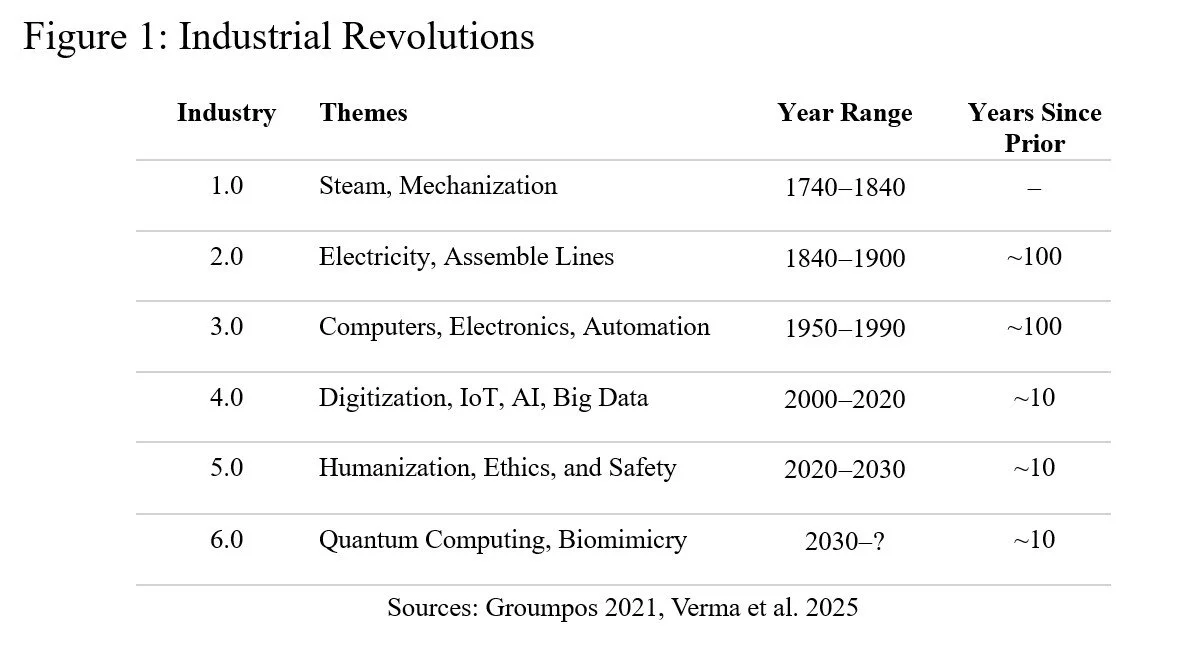
Industry 5.0 is also noteworthy for its influence in spawning several supporting and complimentary initiatives such as:
Management 5.0: stressing human-centric leadership (from hierarchy to enhanced human potential), improved employee experience and engagement, coaching, empathy, shared purpose, and human flourishing.
Circular economy 5.0: moving from “reduce-reuse-recycle” to regenerating natural, social, and economic systems, net-positive impact, systems designed for human well-being, improved quality of life, greater trust, and reinforced accountability.
Society 5.0: Specific to Japan, it aims to address several societal challenges by moving beyond Industry 4.0’s productivity focus to a more human-centric, inclusive, technologically integrated, “super-smart” society.
It is critical to note two highly important aspects of 5.0. First, all the 5.0 initiatives, with their focus on human-centricity, should be considered relevant to any industry or organization, not merely manufacturing. Improving the human condition is a universal goal that is badly needed in all industries on a global scale. Second, the single most important outcome of all 5.0 initiatives is the shifting of organizational focus and priorities from a shareholder value to a stakeholder value viewpoint (see Figure 2), which is the best way to promote the emergence of human-centricity, resilience, and sustainability (Szelągowski and Berniak-Woźny 2024). Here, stakeholders are inclusive of shareholders to avoid competitive, zero-sum thinking. This is not an either-or debate; it’s an opportunity for all to benefit from organizational success.
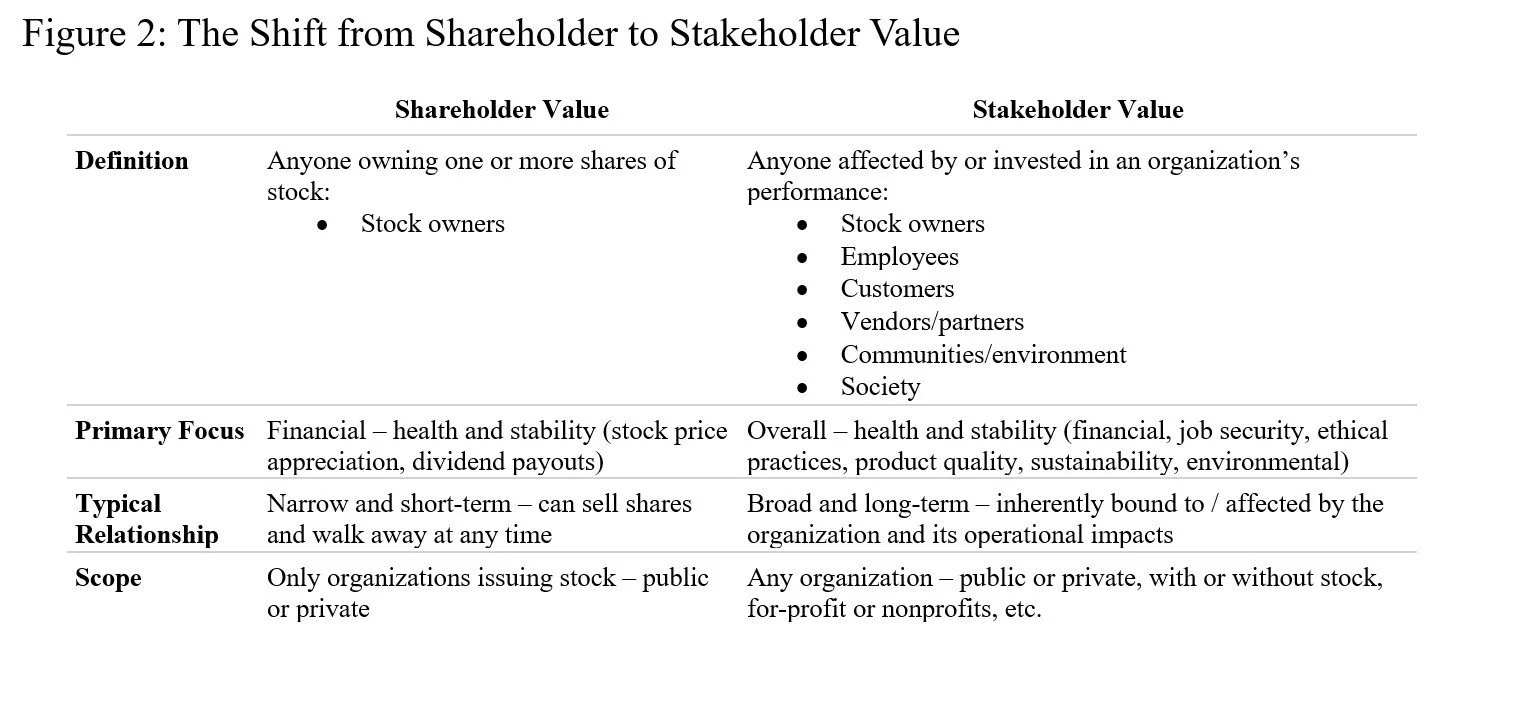
A stakeholder viewpoint is synonymous with systems thinking (i.e., seeing the whole vs. separate parts, adopting a big-picture long-term outlook, and understanding the interconnectedness of it all). It is illogical to think that the well-being of an organization can be advanced independent of the well-being of its employees, communities, industry, society, and the natural systems upon which it depends (Senge 2006).
The cautionary note regarding our technologically stoked acceleration into the future is that we must see 5.0 to its fully realized, human-centric conclusion without abandoning it for the next shiny object. Never before has there been such a concerted effort and positive vision for improving the human condition based on the principles of intellectual engagement, dignity, equality, empathy, purpose, etc. We must not let 5.0 slip through our fingers.
Recommendations: Regardless of the arbitrary timing of our continuous journey into higher and higher levels of industry, achieving 5.0 is now, and will likely forevermore be, the single most critical organizational imperative. The timeless elements of 5.0, of which employee engagement is an outcome, will enable organizational resilience and sustainability. The following recommendations support both:
Be in charge. Improving employee engagement requires the ability to control the definition of who the organization serves—shareholders vs. stakeholders. Publicly traded organizations are motivated by short-term thinking and actions, which only satisfy the stock market and benefit shareholders. They typically are not friendly to employees (Martin 2021). If possible, keep your organization private, or take it private, so you can choose whom to serve. If you are public, it is still worth pursuing the following approaches.
Be generous. Public and private organizations can both issue stock. In addition to adopting all of 5.0’s human-centric beliefs and practices, the next best thing is to offer an employee stock ownership plan (ESOP) to motivate them to think and act like owners, develop a long-term stake in the company, and have better interactions with customers (Martin 2021).
Be brave. Rethink business as usual and develop humanistic approaches to organizing and managing that can respond to the many human tragedies in the world, reduce employee suffering, and foster well-being through transformative organizational changes such as process orientation and business process management (Town et al. 2024).
Be mindful. Mindfulness is central to better organizational performance. It is the art of creating order out of chaos. Accept and work within the three organizational realities: impermanence, that everything is always changing; unsatisfactoriness, fear due to our inability to secure lasting order; and selflessness, how all organizational actions are interconnected. Continuous mental effort and organizing are required to remain resilient (Weick and Putnam 2006).
Be empathetic. Put yourself in the shoes of the average employee. What the whole world wants is simple—a good job. Maximizing human potential will have a positive impact not only on organizations but on nations and the world’s productivity. Employees are looking to the workplace more and more for a sense of meaning, identity, and recognition as worthy human beings (Gallup 2016, 2019).
Be kind. Keeping with the 5.0 mantra of making employees the centerpiece of strategy and executional practices, it is important to provide gratifying work experiences; hire and train managers who value, respect, and trust employees; and offer an abundance of opportunities for employees to grow, excel, and advance their careers (Bernstein et al. 2024).
Leaders must fully understand and embrace the correlation and causation between the health of the workplace and achieving desired results. Workplace health is the single best pathway to trigger the cascading sequence from employee engagement to strategic execution to customer satisfaction to overall performance. The very existence of the suite of 5.0 initiatives validates this belief and sets a north star.
Stay tuned for MORe insights and recommendations.
References:
Bernstein, Ethan, Michael B. Horn, and Bob Moesta. 2024. “Why Employees Quit.” Harvard Business Review 102 (6): 44-54.
Gallup. 2016. First, Break All the Rules: What the World’s Greatest Managers Do Differently. Gallup Press.
Gallup. 2019. It’s the Manager: Moving from Boss to Coach. Gallup Press.
Gallup. 2026. “Why Does Employee Engagement Research Matter?” https://www.gallup.com/394373/indicator-employee-engagement.aspx.
Gladwell, Malcolm. 2000. The Tipping Point: How Little Things Can Make a Big Difference. Little, Brown and Company.
Groumpos, Peter P. 2021. “A Critical Historical and Scientific Overview of All Industrial Revolutions.” IFAC-PapersOnLine 54 (13): 464–71. https://doi.org/10.1016/j.ifacol.2021.10.492.
Harter, Jim, and Ryan Pendell. 2026. “Global Employee Engagement Continues Decline.” Gallup. https://www.gallup.com/workplace/708071/global-employee-engagement-continues-decline.aspx.
Martin, Roger L. 2021. “It’s Time to Replace the Public Corporation.” Harvard Business Review 99 (1): 34–42. research.ebsco.com/plink/679d0d49-0beb-34e6-82d6-d4a8ed238519.
Senge, Peter. 2006. The Fifth Discipline: The Art & Practice of the Learning Organization. Doubleday.
Shuck, Brad. 2019. Employee Engagement: A Research Overview. Taylor & Francis Group. https://doi.org/10.4324/9781351035064.
Szelągowski, Marek, and Justyna Berniak-Woźny. 2024. “BPM Challenges, Limitations and Future Development Directions – A Systematic Literature Review.” Business Process Management Journal 30 (2): 505–557. https://doi.org/10.1108/BPMJ-06-2023-0419.
Szelągowski, Marek, Justyna Berniak-Woźny, Piotr Sliż, et al. 2024. “Exploring the Diverse Nature of Business Processes in Organisations in Industry 4.0/5.0.” Future Business Journal 10 (118): 1–15. https://doi.org/10.1186/s43093-024-00395-5.
Town, Sophia, Christopher S. Reina, Boris H. J. M. Brummans, and Michael Pirson. 2024. “Humanistic Organizing: The Transformative Force of Mindful Organizational Communication.” Academy of Management Review, 49 (4): 824–847. https://doi.org/10.5465/amr.2021.0433.
Verma, Ashwin, Vivek Kumar Prasad, Aparna Kumari, et al. 2025. “Industry 6.0: Vision, Technical Landscape, and Opportunities.” Alexandria Engineering Journal 130 (October): 139–74. https://doi.org/10.1016/j.aej.2025.08.040.
Weick, Karl E., and Ted Putnam. 2006. “Organizing for Mindfulness: Eastern Wisdom and Western Knowledge.” Journal of Management Inquiry 15 (3): 275–87. https://doi.org/10.1177/1056492606291202.
Low engagement results in the inability of organizations to weather disruption and change.
Improved organizational performance begins with engaged employees—which is why we need “5.0.”
The single most important outcome of all 5.0 initiatives is the shifting of organizational focus and priorities from a shareholder value to a stakeholder value viewpoint.
We must see 5.0 to its fully realized, human-centric conclusion; we must not let it slip through our fingers.